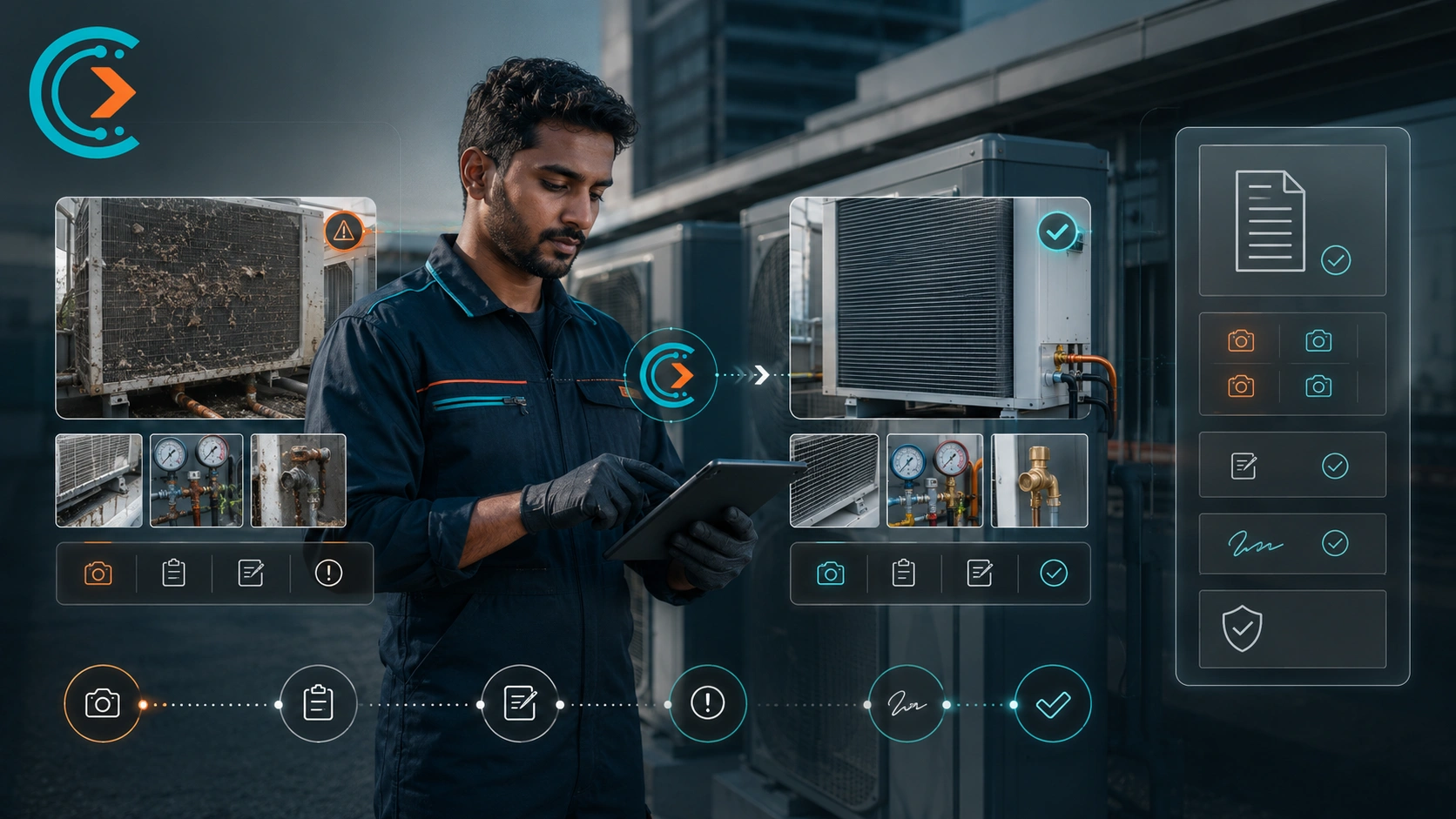
What Proof Is Required Before Field-Service Job Closeout?
A practical manager framework for checking job context, required evidence, exceptions, confirmation, and review ownership before a field-service record is closed.
Step-level photos, timestamps, notes, exceptions, signoff, and verification that make field work easier to review.
CoSkip explores proof of work through the lens of guided work, proof capture, field conditions, human review, and focused pilots that start with one real workflow.
This topic hub connects field realities, product decisions, proof requirements, and the next practical step for teams evaluating CoSkip.
Apply for Pilot AccessProof of work matters because field teams often lose time after the job is done: chasing missing photos, rebuilding notes, clarifying exceptions, reviewing incomplete forms, and answering customer or warranty questions.
CoSkip's point of view is practical: guide the workflow as it happens, capture proof at the step level, and turn close-out into a record supervisors can review without reconstructing the work later.
Capture the record while the technician is still in the workflow.
Make photos, notes, exceptions, and signoff part of the step instead of a separate chore.
Structured proof helps teams review the work without chasing context.
Operational friction is easiest to test when one repeatable workflow has clear outcomes.
A practical manager framework for checking job context, required evidence, exceptions, confirmation, and review ownership before a field-service record is closed.
Published CoSkip writing appears first. Planned editorial cards are clearly labeled and do not link to non-existent articles.
Photos and notes are only useful when they explain the job. Learn what technicians should capture before closeout so managers, warranty teams, and the back office can review the work with clearer context.
A field workflow is ready for an AI pilot when its procedure, proof rules, exceptions, owners, review path, and pilot boundary are clear enough to guide and measure.
A field-service job is not truly complete when the technician leaves the site. Learn what proof, notes, exceptions, signoff, manager review, and back-office handoff should be captured before closeout.
Warranty disputes often start when field proof lacks context. Learn how photos, notes, exceptions, timestamps, signoff, and closeout details can become a review-ready proof packet.
Field-service consistency does not come from more meetings or longer PDFs. Repeatable work needs guidance inside the workflow: steps, proof prompts, exception capture, notes, signoff, and review-ready output.
Before a field AI pilot, prepare one target workflow, approved source materials, sample jobs, proof requirements, device assumptions, field leads, reviewers, security needs, system handoffs, and success metrics.
The safest way to pilot field service AI is to choose one repeatable, proof-heavy workflow and define the steps, proof requirements, users, source materials, systems, review paths, and success metrics before expansion.
Technician adoption for field service AI depends on workflow fit, field usability, source trust, proof prompts, supervisor support, and feedback loops. Use this checklist before asking technicians to change how they work.
A field service AI copilot is different from a chatbot because it is tied to workflow steps, approved source context, required proof, exception status, and closeout records. A chatbot may answer questions, but field teams need help completing and proving the work.
An AI technician assistant is not a replacement for a skilled technician. It is a workflow support layer that helps field teams follow repeatable steps, capture required proof, flag exceptions, and create review-ready closeout records.
Warranty documentation gaps usually appear after the technician leaves, when supervisors, admin teams, or warranty reviewers try to reconstruct what happened. This guide explains the most common gaps and how to close them before the job is submitted.
Proof packets help warranty reviewers by organizing the job story into a structured record. The goal is not a longer report. The goal is a cleaner record with the evidence, exceptions, and context needed for review.
Before-and-after evidence can be one of the most useful parts of a warranty record, but only when the photos are tied to the workflow, technician notes, timestamps, exceptions, and closeout context.
Warranty proof of work is the evidence layer behind a warranty-related job. It shows what happened, what was observed, what proof was captured, what exceptions remain, and what reviewers need after the work is complete.
Warranty documentation is easier to review when proof is captured during the job and organized into a clear record. This checklist shows what field teams should capture before a warranty-related job is considered review-ready.
HVAC proof of work is more than a few job photos. It connects each piece of evidence to the workflow step, technician note, exception, signoff, and reviewer path.
HVAC warranty documentation is easier to review when proof is captured during the job. This checklist shows what evidence, notes, exceptions, and closeout details teams should organize before warranty review.
First-time fix rate is one of the most important HVAC service metrics, but it is hard to improve if teams cannot see what happened during the job. This guide explains how to measure it and how proof capture supports improvement.
HVAC callbacks are not only a technical issue. They can also be a workflow, documentation, exception, review, and proof problem. This guide explains how to use guided work and better closeout evidence to support callback reduction.
HVAC PM closeout should be created while the work is happening, not reconstructed later from camera rolls, notes, and calls. This checklist shows what to capture before a preventive maintenance visit is considered review-ready.
Build a field service proof-of-work checklist by defining steps, required photos, notes, exceptions, signoff, and closeout review.
A field service proof packet should include job context, completed steps, photos, timestamps, notes, exceptions, signoff, and closeout summary.
Photo documentation captures images. Proof of work connects photos to workflow steps, timestamps, notes, exceptions, signoff, and closeout context.
See field service proof-of-work examples for HVAC, plumbing, sewer and drain, electrical, roofing, facilities, utilities, and warranty repair.
Field service proof of work is structured job evidence showing what happened, who completed it, what proof was captured, and what remains open.
Field service teams need more than a completed checkbox. Learn how proof packets improve job closeout records, reduce disputes, support technicians, and give operations teams trusted evidence of work performed.
Callbacks drain margins and technician morale. This deep-dive playbook shows how to cut callbacks by ~30% using voice-guided workflows, proof-of-work capture, and a pragmatic 60-day rollout plan—without adding paperwork.
These are editorial previews, not published articles.
A practical look at workflow prompts, proof requirements, review loops, and pilot design for field teams.
The workflow, device, proof, privacy, and operations questions that make a focused pilot easier to evaluate.
How photos, notes, timestamps, exceptions, signoff, and step verification can become a cleaner proof packet.
How missed steps, incomplete proof, and weak close-out records create avoidable return visits.
Explore topic10 insightsTurning repeatable field procedures into guided steps, proof requirements, exceptions, and reviewable records.
Explore topic7 insightsGuidance, training, workflow support, and proof capture that helps technicians complete repeatable work.
Explore topic3 insightsDocumentation, review, retention, proof requirements, and field records teams can audit.
Explore topic5 insightsOperational realities for teams guiding, documenting, and reviewing work outside the office.
Explore topicFor CoSkip, proof of work connects to the operational gap between completed work and trusted close-out records. The work happens in the field. The proof should too.
The technician receives a clear voice or visual cue tied to the workflow.
The technician confirms the condition, notes the issue, or records an exception.
Photos, timestamps, notes, and signoff connect to the exact step.
The completed workflow becomes a proof packet for review.
When photos, notes, exceptions, and signoff are disconnected from the workflow, teams lose time to follow-up, rework, warranty friction, and customer questions.
Check whether your workflow, procedure library, devices, proof requirements, and pilot team are ready.
Get Readiness Score ROI CalculatorEstimate the cost of missing proof, callbacks, paperwork, admin review, and close-out friction.
Calculate ROI Interactive DemoSee how guided work can become step-level proof and a close-out record.
Try Demo Sample Proof PacketReview what structured proof can include: photos, timestamps, notes, exceptions, signoff, and verification.
View Sample Proof Packet Security & TrustReview privacy, data handling, SSO/SAML, MDM, retention, subprocessors, and compliance roadmap resources.
View Security & Trust Pilot ProgramBring one workflow and test CoSkip with a focused 6-10 week path.
Apply for Pilot AccessProof of work connects to the practical work of guiding technicians, capturing proof, reviewing exceptions, and closing out jobs with a clearer record.
CoSkip helps teams guide field work in real time and prove every step with photos, timestamps, notes, exceptions, signoff, and step verification.
Field-service leaders, operations teams, technical buyers, technicians, supervisors, warranty teams, and anyone evaluating practical AI for repeatable field workflows.
Start with one repeatable workflow, gather sample procedures and proof requirements, choose a field lead, and test guidance plus proof capture in real field conditions.
Use the Field AI Readiness Score, review the Sample Proof Packet, try the Interactive Demo, or apply for CoSkip Pilot Access.
If proof of work could help your team guide work, capture proof, and close out with less friction, start with one workflow and test it in real field conditions.