
Learn how HVAC teams can measure first-time fix rate and support improvement with guided workflows, proof capture, exceptions, and review.
HVAC first-time fix rate measures the share of service issues resolved without an avoidable repeat visit. Teams can support improvement by giving technicians better workflow guidance, capturing proof during the job, documenting exceptions, and reviewing repeat visit reasons.
The metric is useful only when the definition is consistent. Decide which job types count, which repeat visits are avoidable, and how exceptions such as parts, approvals, access, or customer decisions are classified.
Simple formula
First-time fix rate = jobs resolved on the first visit / total service jobs measured
The denominator matters. Some teams measure all service jobs. Others measure a subset of comparable repair or maintenance workflows. The important part is consistency: define the service population, define avoidable repeat visits, and apply the rule the same way during the pilot.
Do not compare your HVAC first-time fix rate to a benchmark unless the service mix and definitions match. A commercial rooftop workflow, residential service workflow, warranty repair workflow, and maintenance closeout workflow can all have different repeat visit patterns.
What affects HVAC first-time fix rate?
Job context
Technicians need the right site, asset, customer, prior issue, and workflow context.
Technician workflow consistency
Configured steps make it easier to compare how work was completed across visits.
Parts or approval uncertainty
Some repeat visits are driven by parts, approvals, access, or customer decisions rather than technician execution.
Documentation quality
Missing proof makes it harder to see whether the issue was resolved or what remained open.
Exception handling
Open items must remain visible so the team does not confuse blocked work with failed work.
Supervisor review
Review-ready closeout helps classify repeat visit reasons more consistently.
Why FTFR is hard to improve without proof
First-time fix rate becomes hard to improve when the team cannot tell what happened during the first visit. Was the repeat visit caused by a technical issue, missing context, incomplete proof, a customer expectation gap, parts or approval constraints, unclear closeout, or an unresolved exception? Without a structured record, the answer often becomes anecdotal.
Proof capture supports FTFR improvement by attaching evidence to the workflow step. It helps supervisors see whether required steps were completed, proof was captured, exceptions were flagged, and the closeout record was reviewable before the job was considered done.
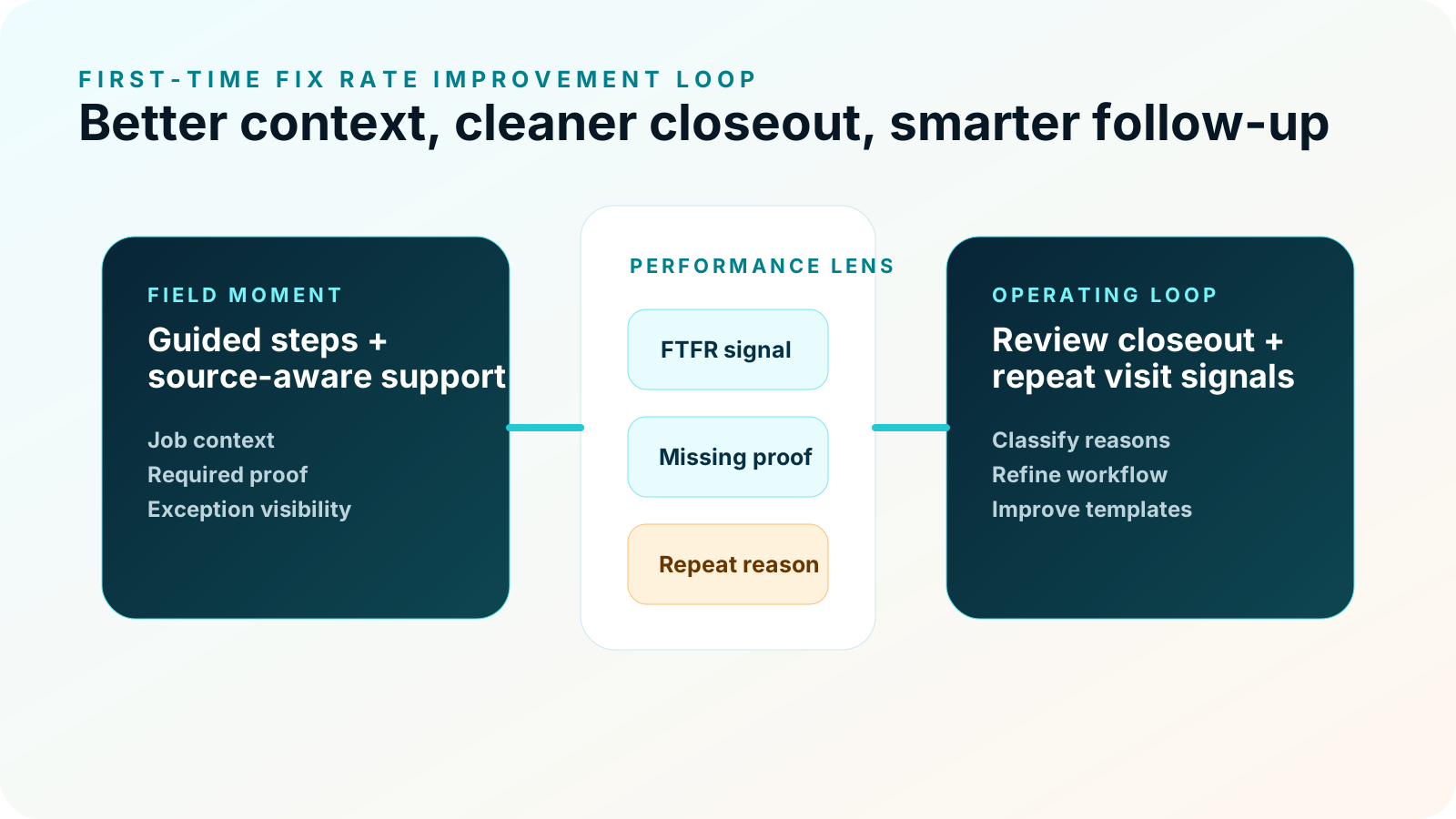
FTFR improvement loop
Choose one repeatable service or closeout path to measure.
Attach site, asset, customer, and work order context where available.
Prompt technicians through the configured workflow.
Capture photos, notes, timestamps, signoff, and exception details.
Use the proof packet to classify whether the job was review-ready.
Separate avoidable repeat visits from blocked, deferred, or customer-driven cases.
Improve prompts, proof requirements, and training based on repeat patterns.
Metrics to track alongside FTFR
FTFR alone does not tell the whole story. Track supporting signals that explain why repeat visits happen and whether the workflow is getting more reviewable.
Track repeat visits connected to the selected workflow.
Measure required evidence gaps at closeout.
Review unresolved conditions and follow-up needs.
Classify repeat visits with enough detail to improve the process.
Measure whether proof packets reduce reconstruction work.
Review whether warranty-related proof is complete enough for review.
Track whether technicians can follow the configured guidance in real work.
Review whether customers receive a clearer record of completed work and open items.
Improve the visibility behind first-time fix rate.
CoSkip can support guided workflows, proof prompts, exception capture, proof packets, and pilot measurement for one HVAC workflow.
How CoSkip supports FTFR improvement
CoSkip can help HVAC teams guide repeatable workflows, surface approved context where configured, prompt required proof, capture exceptions, and assemble proof packets for review. That can make first-visit outcomes easier to inspect during a focused pilot.
CoSkip does not guarantee first-time fix improvement. It also does not replace technicians, supervisors, safety procedures, manufacturer guidance, warranty terms, or the field service management system. It supports the work by making the workflow and proof record easier to execute and review.
Relationship to callbacks
Callbacks are one of the clearest ways first-time fix rate shows up operationally. A repeat visit may reduce FTFR depending on how the business defines avoidable repeat work. The guide on how to reduce HVAC callbacks goes deeper on repeat visit reasons, proof gaps, and closeout review.
The commercial reduce HVAC callbacks page can help connect this article to pilot scoping and business case work.
Pilot plan
Start with one workflow where repeat visits are visible enough to measure. Define the steps, required proof, exception rules, and review criteria. Then use the proof packet to classify repeat visit reasons instead of relying on memory.
Use the pilot program, Field AI readiness score, and ROI calculator when you are ready to scope the workflow.
Choosing the denominator and exclusions
First-time fix rate can become misleading when the denominator is unclear. A team that includes every maintenance visit, warranty repair, customer-requested return, parts delay, and inaccessible site in one number may end up with a metric that is hard to act on. Before using FTFR in a pilot, define exactly which jobs are included.
For a focused HVAC pilot, it is often better to measure one workflow first. That could be a service-call closeout, warranty repair closeout, PM follow-up path, or another repeatable workflow where repeat visits can be categorized consistently. You can still track broader FTFR later, but the first pilot should make the workflow easier to understand.
| Decision | Questions to answer | Why it matters |
|---|---|---|
| Included jobs | Which HVAC workflow, customer segment, or job type is included? | Keeps the metric comparable across pilot jobs. |
| Repeat window | How long after the first visit can a repeat count against the workflow? | Prevents inconsistent callback or repeat-visit labeling. |
| Avoidability | Which repeat visits are avoidable, blocked, customer-driven, deferred, or out of scope? | Separates operational improvement opportunities from unrelated events. |
| Evidence standard | What proof must be present before the first visit is considered review-ready? | Links FTFR to the quality of the closeout record. |
Classifying first-visit outcomes
A first visit does not always end with a simple success or failure. Some jobs are resolved. Some are correctly deferred. Some require a follow-up because of parts, approval, access, customer decisions, warranty review, or unresolved conditions. A proof packet can make those distinctions clearer.
The workflow was completed, required proof was captured, and no avoidable repeat was needed.
The record shows a parts, approval, access, or customer-related reason for follow-up.
The packet includes an exception status and clear follow-up ownership.
The work may have been completed, but proof was missing or disconnected from the step.
The repeat reason points to workflow, proof, closeout, or process friction that can be improved.
The packet lacks enough evidence to classify the outcome reliably.
Using FTFR without blaming the field
FTFR can become counterproductive if it is treated only as a technician score. Repeat visits can reflect job context, scheduling, parts availability, customer expectations, system data, warranty rules, or unclear closeout standards. The point of a guided workflow pilot is to improve the operating system around the technician, not to oversimplify the cause of every repeat visit.
Use the metric to ask better questions. Did the technician have the right context? Was the workflow clear? Were the required photos and notes captured? Was an exception visible before closeout? Did the supervisor have enough evidence to review the record? Those questions lead to practical workflow improvements.
Using proof packets in FTFR reporting
A proof packet gives first-time fix reporting a record to inspect. Without the packet, the team may only know that a repeat visit occurred. With the packet, the team can review whether the workflow was followed, whether required proof was captured, whether an exception was visible, whether the customer handoff was clear, and whether the repeat reason was avoidable.
This does not mean every packet needs a long review. For a pilot, review a sample of jobs: first-visit successes, avoidable repeats, deferred visits, and unknown outcomes. Compare the packet quality across those groups. If avoidable repeats show missing proof, unclear exceptions, or weak closeout notes, the workflow can be improved. If deferred visits are clearly documented, they should not be treated the same way as avoidable repeats.
FTFR reporting gets better when the evidence standard and metric definition are aligned. The measurement should not reward incomplete closeout or punish correctly documented follow-up. It should help the team understand which workflows can be improved through guidance, proof capture, and clearer review.
HVAC first-time fix rate FAQs
What is HVAC first-time fix rate?
HVAC first-time fix rate measures the share of service issues resolved without an avoidable repeat visit.
How do you calculate HVAC first-time fix rate?
Divide jobs resolved on the first visit by the total service jobs measured, using a consistent definition for job type and avoidable repeat visits.
What is a good HVAC first-time fix rate?
It depends on service mix, customer type, parts and approval constraints, warranty rules, and how the company defines repeat visits. Avoid unsupported benchmarks.
Can CoSkip improve first-time fix rate?
CoSkip can support improvement efforts by guiding workflows, capturing proof, flagging exceptions, and improving review visibility, but it does not guarantee improvement.
Does CoSkip guarantee FTFR improvement?
No. Results depend on workflow, technician adoption, procedure quality, current systems, customer context, and pilot scope.
How does proof capture support FTFR?
Proof capture helps teams see what happened on the first visit and classify repeat visit reasons more consistently.
How are callbacks related to FTFR?
Callbacks are repeat visits that can reduce FTFR when they are defined as avoidable repeat work.
What workflow should we pilot first?
Start with a repeatable HVAC workflow where proof quality, exception handling, closeout review, and repeat visit reasons can be measured.
What should we measure during an HVAC field AI pilot?
Measure FTFR, callback rate, repeat reasons, missing proof, exception frequency, closeout review time, and technician adoption.
