Operations leaders
Find the proof gaps that create review drag, callback ambiguity, or closeout friction.
Use this scorecard to identify where proof breaks down in one field workflow before supervisors, customers, warranty teams, or operations leaders have to reconstruct the job later.
Score workflow clarity, required evidence, photo context, notes, exceptions, signoff, reviewer handoff, and closeout quality. The result is directional, not a formal audit.
It is built for operations leaders, field supervisors, warranty and quality reviewers, contractor managers, and pilot teams preparing one proof-heavy workflow for AI-guided field work.
After identifying the weakest category, use an AI-assisted field workflow example to see how guidance, proof prompts, and review status can connect.
Find the proof gaps that create review drag, callback ambiguity, or closeout friction.
Clarify what evidence should be captured before technicians leave the job.
Identify missing proof that slows repair, warranty, or customer review.
Decide whether one workflow has enough proof structure for guided work.
Pick a repeatable workflow that creates review friction today.
Use 0 for missing, 1 for inconsistent, 2 for partially defined, and 3 for reliable.
Look for categories that would make a proof packet hard to trust or review.
Use the result to plan a checklist, proof packet, teardown, or pilot review.
The score is a directional assessment, not a formal audit, guarantee, or pilot acceptance decision. If JavaScript is unavailable, use the visible options and total the values manually.
Proof is missing or disconnected. Reviewers likely chase photos, notes, and context after the job.
Evidence exists, but the closeout depends too much on technician habit and manual follow-up.
The workflow has structure, but some proof, exception, or reviewer handoff gaps remain.
The workflow is easier to translate into guided steps, required proof, and pilot-ready closeout.
PM steps, condition photos, readings, exceptions, and closeout summary.
Diagnostics, repair evidence, customer handoff, and closeout status.
Inspection footage context, blockage notes, approvals, and completion proof.
Inspection evidence, readings, safety-sensitive documentation, and signoff.
Exterior area evidence, damage photos, materials, and customer-ready review.
Contractor proof, site notes, recurring checks, and operations review.
Asset evidence, field notes, exceptions, contractor handoff, and review trails.
Before/after evidence, parts notes, repair action, rationale, and review path.
CoSkip can help teams guide the workflow, prompt required proof, capture exceptions and signoff, and assemble review-ready proof packets depending on pilot scope.
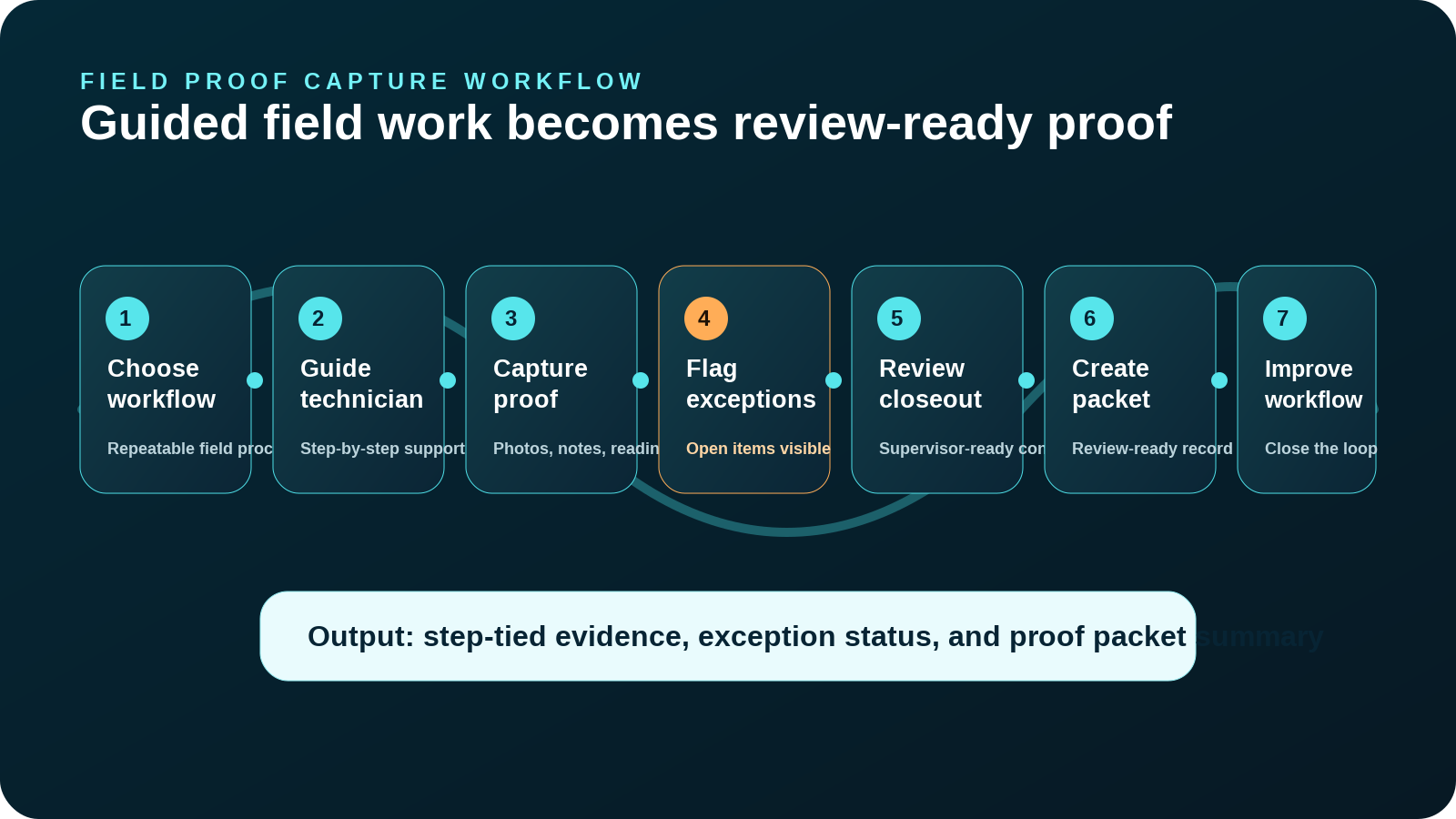
Map steps, required proof, exception paths, reviewer ownership, and pilot fit for one workflow.
Define what proof should be required before trying to automate or pilot the workflow.
Clarify final work status, exceptions, signoff, and closeout summary expectations.
Assess source materials, devices, reviewers, systems, metrics, and pilot ownership.
Model repeat visit cost, proof follow-up, warranty friction, and admin review.
See how captured proof can become a closeout packet for review.
Photo documentation, close-out software, proof-of-work template, warranty proof, and warranty documentation.
Resources, interactive demo, ROI calculator, readiness score, and pilot program.
Trust and integrations help teams plan data, access, export, API, webhook, and system handoff questions.
The Field Proof Gap Scorecard is a directional worksheet for scoring where job evidence breaks down across workflow clarity, required proof, photos, timestamps, notes, exceptions, signoff, reviewer handoff, and closeout quality.
A field proof gap is a missing or inconsistent piece of evidence that makes a completed job harder to review after the technician leaves.
Choose one repeatable workflow and score each category from 0 to 3 based on how reliably the proof is defined, captured, and reviewable today.
A higher score can indicate a stronger proof foundation, but it is not pilot acceptance. Use the score with readiness, ROI, workflow ownership, and pilot scoping.
No. The scorecard is a directional planning tool, not a formal audit, certification, legal review, warranty decision, or pilot acceptance decision.
The scorecard diagnoses current proof gaps. The proof-of-work checklist helps define what proof the workflow should capture going forward.
Yes. It can help identify weak before-and-after evidence, repair notes, exception handling, signoff, and reviewer handoff without guaranteeing warranty outcomes.
Start with a repeatable, proof-heavy workflow where missing evidence creates supervisor follow-up, customer disputes, warranty friction, callbacks, or closeout delays.
CoSkip can help turn proof requirements into guided workflow prompts, exception capture, signoff, and proof packets depending on pilot scope.
Use the scorecard with the callback worksheet and pilot readiness worksheet to choose the strongest first workflow for guided work and proof capture.