
Reduce HVAC callback risk by improving workflow consistency, proof capture, exception visibility, closeout review, and pilot measurement.
To reduce HVAC callbacks, start with one repeatable workflow, define the required steps, capture proof at the source, document exceptions before closeout, review the record consistently, and measure repeat visit reasons over time.
Callback reduction is not just a technician skill issue. It is also an operating system for job context, proof capture, exception visibility, closeout review, and learning from repeat visit patterns.
What causes HVAC callbacks?
This guide does not provide HVAC repair instructions or technical diagnosis guidance. Instead, it focuses on the operational causes that make callback risk harder to see and manage. Even when the underlying issue is technical, the team still needs a reliable record of what happened, what proof was captured, and what exceptions were visible before closeout.
Missed or inconsistent steps
Technicians may close the same service workflow in different ways, making outcomes hard to compare.
Incomplete job context
Asset history, customer notes, prior issues, approval constraints, or scope details may be missing.
Missing proof
Photos, notes, readings, timestamps, or signoff may not be captured before the job closes.
Unclear exceptions
Unresolved conditions, customer questions, or follow-up needs get buried in notes or texts.
Inconsistent closeout review
Supervisors cannot consistently review what happened when the record is incomplete.
Documentation gaps
Warranty or admin review may require before/after context that was not captured during work.
Callback reduction is not more paperwork
Paperwork after the job often increases friction without improving the record. The technician is already away from the system, the context is fading, and the missing proof may no longer be available. That is why callback reduction should focus on proof captured during the workflow, not documentation reconstructed afterward.
Good checklist discipline helps technicians because it tells them what evidence matters before closeout. Bad checklist discipline adds boxes nobody trusts. The difference is whether the checklist is tied to one real workflow, a clear reviewer, and a practical proof standard.
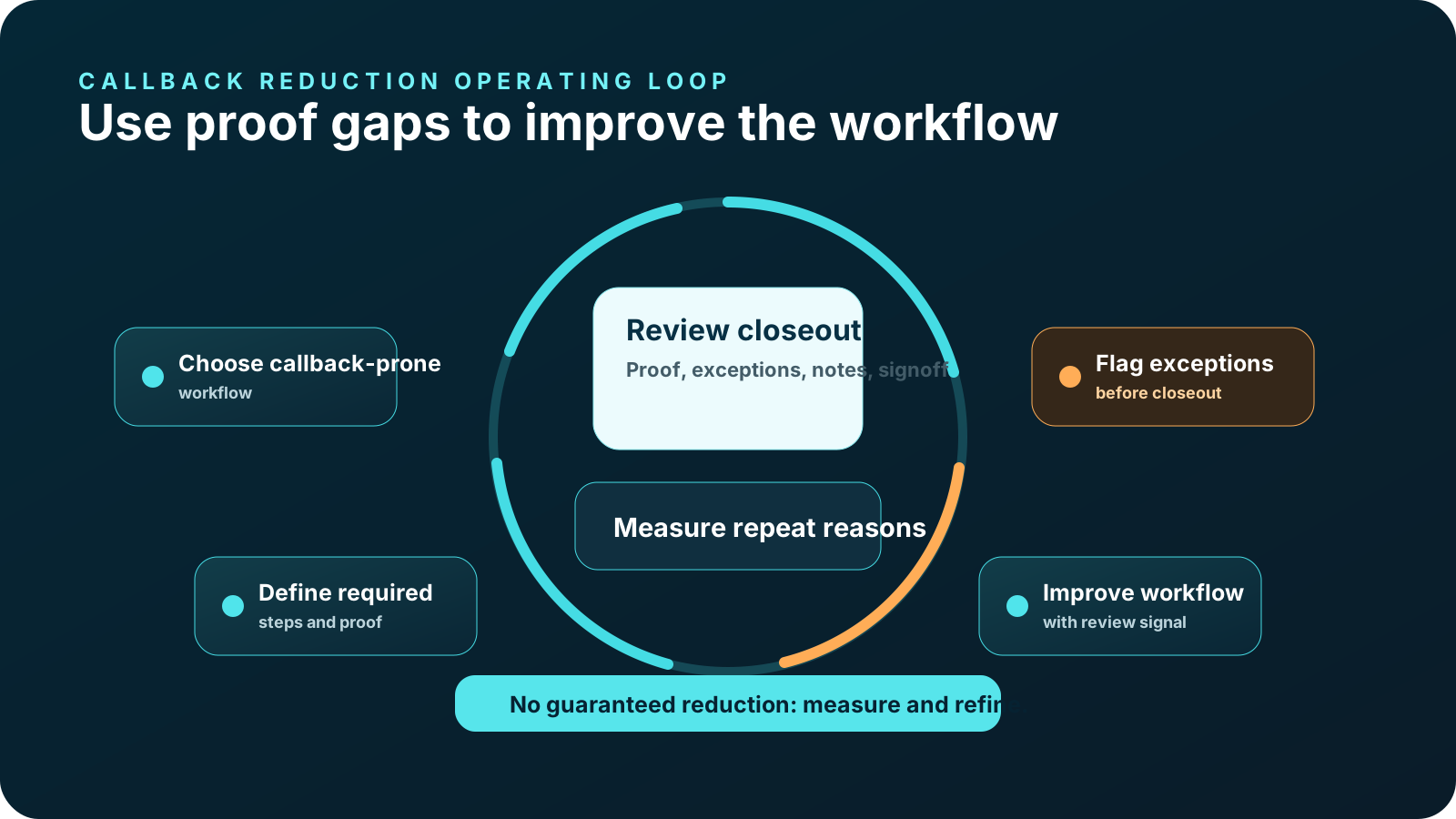
Callback reduction operating loop
Start with one callback-prone or repeatable service path.
Clarify the steps technicians should follow and reviewers should inspect.
Attach required photos, notes, timestamps, signoff, and exception rules.
Prompt the next step and proof requirement during the job.
Keep unresolved issues visible before closeout.
Inspect proof quality before the record is considered review-ready.
Classify callbacks by operational reason instead of relying on memory.
Use patterns to improve prompts, proof requirements, and training.
Where proof capture helps
Proof capture does not guarantee fewer callbacks. It supports callback reduction efforts by helping the team see what happened. When photos, timestamps, notes, signoff, and exceptions are tied to workflow steps, supervisors can distinguish between missing proof, unresolved work, customer expectation gaps, warranty documentation gaps, and other operational patterns.
- Photos tied to the step make the evidence easier to interpret.
- Timestamps show when proof was captured during the workflow.
- Technician notes explain condition, action, and follow-up context.
- Exception flags keep unresolved items visible before the job closes.
- Customer or technician signoff can support handoff where configured.
- Supervisor review becomes a structured packet review, not a reconstruction task.
Metrics to track
A useful callback pilot should use your own definitions and operational data. Avoid imported benchmarks that do not match your service mix, customer base, or repeat visit rules.
Track repeat visits connected to the selected workflow.
Classify why the repeat happened with enough detail to improve the workflow.
Measure required proof items absent at closeout.
Track whether supervisors spend less time chasing context.
Identify recurring unresolved conditions and follow-up needs.
Track whether the guided workflow is practical enough to use.
Start callback reduction with one measurable HVAC workflow.
CoSkip can help guide repeatable work, capture proof, flag exceptions, and organize closeout evidence for review depending on pilot scope.
How CoSkip supports callback reduction
CoSkip supports the operational layer of callback reduction. It can guide configured steps, prompt proof capture, keep exception details visible, and assemble proof packets that supervisors can review. The related pages are reduce HVAC callbacks, HVAC proof of work, and field service proof-of-work software.
CoSkip does not guarantee fewer callbacks. Results depend on workflow quality, technician adoption, customer context, parts and approval constraints, current systems, and how the pilot is scoped.
Relationship to first-time fix rate
Callback reduction and HVAC first-time fix rate are connected, but they are not identical. First-time fix rate measures the share of service issues resolved without an avoidable repeat visit. Callback analysis looks at why repeat visits happen and how often they connect to workflow, proof, exception, or closeout issues.
Use the commercial HVAC first-time fix rate page when you are ready to evaluate the metric as part of a guided workflow pilot.
Pilot plan
Start with one callback-prone workflow rather than every service call. Pick a workflow with enough volume to learn, a clear owner, a field lead, and a supervisor who can review proof packets. Then track callback rate, repeat reason, missing proof, exceptions, review time, and adoption.
Use the pilot program, Field AI readiness score, and ROI calculator to decide whether the workflow is ready to scope.
How to classify repeat visit reasons
Callback reduction gets more practical when repeat visit reasons are classified consistently. The goal is not to blame technicians. The goal is to understand whether a repeat visit points to a workflow issue, proof gap, customer expectation gap, missing context, unresolved exception, parts or approval constraint, or another operating condition.
| Repeat reason category | What reviewers look for | Possible workflow response |
|---|---|---|
| Missing proof | Required photos, notes, readings, signoff, or timestamps absent from the packet. | Add or clarify proof prompts before closeout. |
| Unresolved exception | Open issue, access constraint, customer question, or follow-up item not visible at closeout. | Make exception status and ownership mandatory before closing. |
| Workflow variation | Technicians complete the same job path in materially different ways. | Simplify the guided sequence and define which steps are review-critical. |
| Customer context | Expectation, access, approval, or communication issue that influenced the repeat visit. | Capture customer context and handoff notes as part of closeout. |
| Warranty/admin review | Packet missing before/after evidence, parts notes, rationale, or reviewer summary. | Use warranty-specific proof requirements for the selected workflow. |
Build a callback review meeting around proof packets
A callback review meeting is more useful when everyone is looking at the same record. Instead of debating from memory, review the proof packet: job context, steps completed, proof captured, exceptions, signoff, repeat reason, and what the technician or supervisor knew before closeout. This makes the conversation more operational and less anecdotal.
For the first pilot, keep the review cadence lightweight. Look at a small sample of jobs weekly or biweekly. Ask what proof was missing, what exceptions were unclear, what prompts technicians skipped, and which repeat reasons appeared more than once. Then adjust the workflow only when the evidence shows a pattern. Too many changes at once can make adoption harder.
Pick recent jobs from the selected workflow so the context is still fresh.
Look for repeated missing proof, unclear exceptions, or closeout review friction.
Make targeted workflow changes that technicians can understand and follow.
Avoid overcorrecting the workflow
When callbacks are visible, teams can be tempted to add more checkboxes, more required photos, and more review gates. That can backfire. If every step becomes mandatory proof, technicians may slow down, skip prompts, or stop trusting the workflow. The better approach is to identify which proof items actually help reviewers make decisions.
Keep the workflow focused on the repeat visit pattern you are trying to understand. If missing before/after evidence is the problem, solve that first. If exception status is the problem, clarify exception capture. If customer handoff is the problem, improve the closeout summary. Callback reduction improves when the workflow is precise enough to guide behavior without becoming a paperwork burden.
How to keep technicians engaged in callback reduction
Technicians are more likely to follow a callback reduction workflow when the reason for each prompt is clear. If a photo prevents supervisor follow-up, say that. If an exception note protects the technician from being blamed for a blocked job, make that visible. If a closeout summary helps the customer understand the work, keep the prompt short and practical.
A good pilot should include field lead feedback early. Ask which prompts interrupt the job, which proof items are hard to capture, which questions are unclear, and which exception paths happen most often. The goal is to make the workflow easier to complete correctly, not to add hidden administrative work. When technicians see that proof capture reduces calls after the job and makes repeat reasons clearer, adoption is more likely to hold.
That adoption signal is itself a measurement. If technicians skip a prompt repeatedly, the issue may be the prompt, device flow, workflow design, or proof requirement. Review skipped prompts before assuming non-compliance.
HVAC callback reduction FAQs
What causes HVAC callbacks?
Callbacks can come from missed steps, missing context, incomplete proof, unclear exceptions, customer expectation gaps, warranty documentation gaps, or technical conditions that require follow-up.
Can software help reduce HVAC callbacks?
Software can support callback reduction by guiding repeatable workflows, prompting required proof, flagging exceptions, and improving closeout review. It cannot guarantee fewer callbacks.
Does CoSkip guarantee fewer callbacks?
No. CoSkip does not guarantee callback reduction. Outcomes depend on workflow, process, adoption, customer context, technical factors, and pilot scope.
How does proof capture support callback reduction?
Proof capture helps supervisors see what happened during the first visit, what evidence was captured, what exceptions remained, and what repeat reasons appear over time.
How are callbacks related to first-time fix rate?
Callbacks are repeat visits that can reduce first-time fix rate depending on how the business defines avoidable repeat work.
What workflow should we start with?
Start with one repeatable workflow where callbacks, missing proof, exceptions, or closeout review friction are visible and measurable.
What metrics should we track?
Track callback rate, repeat visit reasons, missing proof items, exception frequency, closeout review time, warranty documentation gaps, and technician adoption.
Can proof packets help supervisors review callback risk?
Yes. Proof packets organize steps, evidence, notes, exceptions, and review status so supervisors can inspect the record more consistently.
Does CoSkip replace our FSM?
No. CoSkip supports guided work and proof capture around existing field service systems. Export and integration scope depends on pilot goals.
