
Use this warranty claim documentation checklist to organize before-and-after proof, service steps, parts notes, exceptions, signoff, and review-ready records.
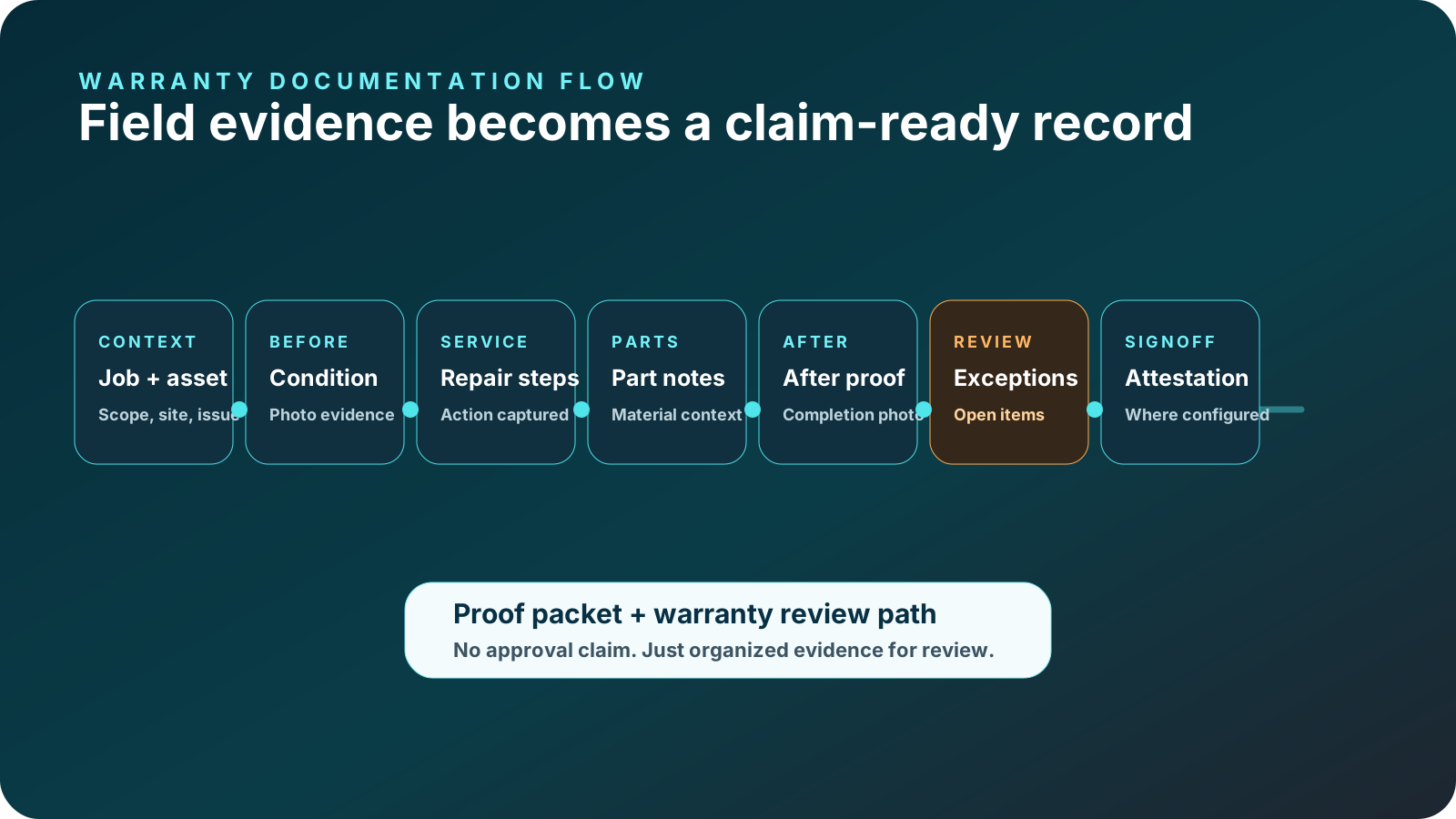
A warranty claim documentation checklist should include job context, before-and-after evidence, service steps, parts notes where applicable, technician observations, timestamps, exceptions, signoff, reviewer status, and a closeout summary.
The best warranty documentation is captured while the work is happening and then organized into a review-ready record. That keeps proof tied to the jobsite moment instead of forcing supervisors or admin teams to reconstruct the record after the technician leaves.
CoSkip supports warranty documentation workflows, but it does not guarantee warranty claim approval, claim reimbursement, reduced denials, ROI, customer approval, or legal sufficiency. CoSkip does not replace warranty terms, manufacturer requirements, technician judgment, safety procedures, field service systems, warranty systems, legal review, claims teams, or supervisor review.
Why warranty documentation matters
Warranty-related work is often reviewed after the field visit. The technician may have left the site, the customer may have follow-up questions, and the reviewer may need evidence that was only obvious while the work was happening. If before evidence, service context, parts notes, technician observations, or exceptions are missing, the review process becomes a reconstruction exercise.
A clear warranty documentation checklist does not guarantee a warranty outcome. It gives the team a practical standard for what should be captured before a job is considered review-ready. That standard helps supervisors, warranty reviewers, operations teams, and technicians align around the same record.
Review happens later
Warranty review often begins after the technician is gone, so the record has to stand on its own.
Photos need context
Before and after photos are stronger when tied to workflow steps, notes, timestamps, and exceptions.
Manual packet assembly is fragile
Office teams lose time when warranty evidence lives across camera rolls, work orders, texts, and memory.
Warranty claim documentation checklist
Use this checklist as an operating model, then adapt it to the warranty workflow, customer agreement, manufacturer requirements, internal review needs, and system constraints your team actually uses.
- AJob and review context
Capture customer, work order, site, asset, technician, workflow type, and the reviewer or review queue that needs the record.
- BEquipment, site, or work order context
Attach asset references, location details, equipment identifiers, service history, or work order context where available and appropriate.
- CBefore evidence
Document the starting condition before the service, repair, inspection, or replacement step begins.
- DService or repair steps
Record the configured steps completed, skipped, blocked, or escalated during the warranty-related workflow.
- EParts notes where applicable
Capture parts, materials, failure context, or service notes when the workflow and reviewer require them.
- FTechnician observations
Add concise observations that explain condition, action, rationale, constraints, or customer context.
- GAfter evidence
Capture after-repair or closeout proof and tie it to the related workflow step.
- HExceptions and follow-up
Flag unresolved conditions, missing proof, blocked steps, customer questions, or work that needs another review.
- ISignoff and reviewer status
Capture technician or customer signoff where configured and identify who reviews the record next.
- JProof packet completeness
Confirm the record includes job context, proof, notes, exceptions, review path, and closeout summary.
- KExport or handoff notes
Document what needs to move into a warranty system, FSM, CRM, document store, or customer-facing record where configured.
What reviewers usually need
A warranty documentation record is not reviewed by one generic audience. Each stakeholder is looking for a different decision path. Build the checklist around those review needs rather than around a generic upload rule.
Needs completed steps, proof completeness, exceptions, and follow-up ownership.
Needs before condition, service action, after evidence, parts context where applicable, and notes.
Needs a clear closeout story with evidence, open items, and signoff where configured.
Needs packet completeness, system handoff, export fields, and reviewer status.
Needs step-tied evidence and visible exceptions without relying on technician memory.
Common warranty documentation mistakes
Most documentation problems are small in the field and large in review. The issue is rarely that no evidence exists. The issue is that the evidence cannot answer the reviewer question without extra calls, texts, or manual reconstruction.
Photos not tied to steps
Images exist, but reviewers cannot tell what workflow step they support.
Missing before evidence
The reviewer can see the closeout state but not the starting condition.
Missing after evidence
The record explains the work but does not show completion context.
Parts notes separated
Parts or material context lives outside the record reviewers inspect.
Exceptions buried
Open issues disappear in freeform notes instead of staying visible.
No closeout summary
The record has artifacts but does not explain the job story.
How proof packets support claim documentation
A proof packet organizes warranty evidence into a structured record. It can include job context, before evidence, service steps, parts notes where applicable, technician observations, after evidence, exceptions, signoff, and a closeout summary. A packet is not an approval engine. It is a cleaner record for review.
Use the sample proof packet to see how a review-ready record can organize proof without making unsupported claims. For a deeper guide, read how proof packets support warranty review.
Turn one warranty workflow into a review-ready record.
Start with one repeatable warranty-related workflow, define the proof standard, and test how the closeout packet should look.
How CoSkip helps warranty documentation
CoSkip can help teams guide configured warranty-related workflows, prompt required proof, capture before-and-after evidence, record parts notes where applicable, attach technician observations, flag exceptions, collect configured signoff, and assemble review-ready proof packets. It works around existing systems rather than replacing your FSM, warranty platform, or claims process.
The best first pilot is narrow: one workflow, one reviewer path, one proof standard, and a small set of sample jobs. Use the Field AI readiness score and ROI calculator to evaluate whether the workflow is ready for scoping.
Claim-ready language to use carefully
Warranty records should be precise. Use phrases such as "ready for warranty review," "before evidence captured," "service step documented," "exception open," or "supervisor review needed." Avoid language that implies guaranteed approval, reimbursement, compliance, or manufacturer acceptance unless that status exists in the appropriate review process.
Workflow examples for the checklist
Repair closeout
Before condition, service action, parts note where applicable, after evidence, exception status, and warranty-ready packet.
Explore warranty repairHVAC warranty documentation
Capture HVAC before/after proof, service steps, notes, exceptions, and closeout records.
Explore HVAC warranty documentationBefore-and-after evidence
Tie photos to workflow steps, timestamps, notes, and reviewer status.
Read before/after guideWarranty proof packet
Organize evidence into a packet a reviewer can inspect without rebuilding the job.
Read packet guideWarranty claim documentation checklist FAQs
What is a warranty claim documentation checklist?
It is a field-service checklist for the proof, notes, exceptions, signoff, and closeout context needed before a warranty-related job is considered review-ready.
What should warranty claim documentation include?
It should include job context, before-and-after evidence, service steps, parts notes where applicable, technician observations, timestamps, exceptions, signoff, reviewer status, and closeout summary.
What proof should technicians capture for warranty review?
Proof depends on the workflow, but it often includes before condition, service action, parts context where applicable, after evidence, technician notes, exceptions, and signoff.
How is claim documentation different from warranty proof of work?
Warranty proof of work is the evidence layer captured during the job. Claim documentation is the organized review package created from that evidence.
Can proof packets support warranty review?
Yes. Proof packets can organize warranty evidence and reviewer context, but they do not guarantee approval.
Does CoSkip guarantee warranty claim approval?
No. CoSkip supports documentation workflows but does not guarantee approval or reimbursement.
Does CoSkip replace our warranty system or FSM?
No. CoSkip supports guided proof capture around existing systems. Export and integration scope depends on pilot goals.
What workflow should we pilot first?
Start with one recurring warranty workflow where missing proof creates review friction or manual packet assembly.
Can documentation be exported?
CoSkip can support export-ready records and integration planning depending on workflow, current systems, and pilot scope.
