Loading...
Back to top
AI Field Guidance Pilot Program

Pilot AI Guidance with Your Field Team

CoSkip pilots help service teams test AI guidance on a focused field workflow. Start with one team, one workflow, and one measurable outcome - then evaluate how voice guidance, visual context, and company knowledge can support technicians in the field.

The fastest way to understand CoSkip is to test voice and visual AI guidance on one real workflow.

  • 6-10 week pilot path
  • One workflow to start
  • 3-5 sample procedures
  • Field lead + operations owner
  • Voice guidance
  • Visual job context
  • Company knowledge
  • Cleaner closeout
Pilot fit

Start with one workflow, one team, and one measurable outcome.

The best field AI pilot does not start everywhere. It starts with one workflow where guidance, escalation reduction, onboarding, closeout quality, or first-time-fix performance can be measured.

Strong pilot fit

  • 10-250 field technicians, or one focused team within a larger organization
  • One repeatable workflow with measurable pain
  • 3-5 sample procedures, checklists, manuals, or expert notes
  • A pilot champion or operations owner
  • 1-2 field leads willing to test and provide feedback
  • A clear success metric such as technician adoption, escalation frequency, search time, closeout completeness, callback patterns, or manager review time

Not ready yet?

  • Workflow is still unclear
  • Procedures are not documented or are scattered
  • No field lead has been identified
  • Metrics are not yet baselined
  • Security or integration owner is unknown
Take the Field AI Readiness Score

Not every team needs to be fully mature to start. The key is choosing one practical workflow and measuring the right outcome.

What you get

What pilot partners get

01

Guided workflow prototype

Voice guidance, visual context, proof rules, and exception paths.

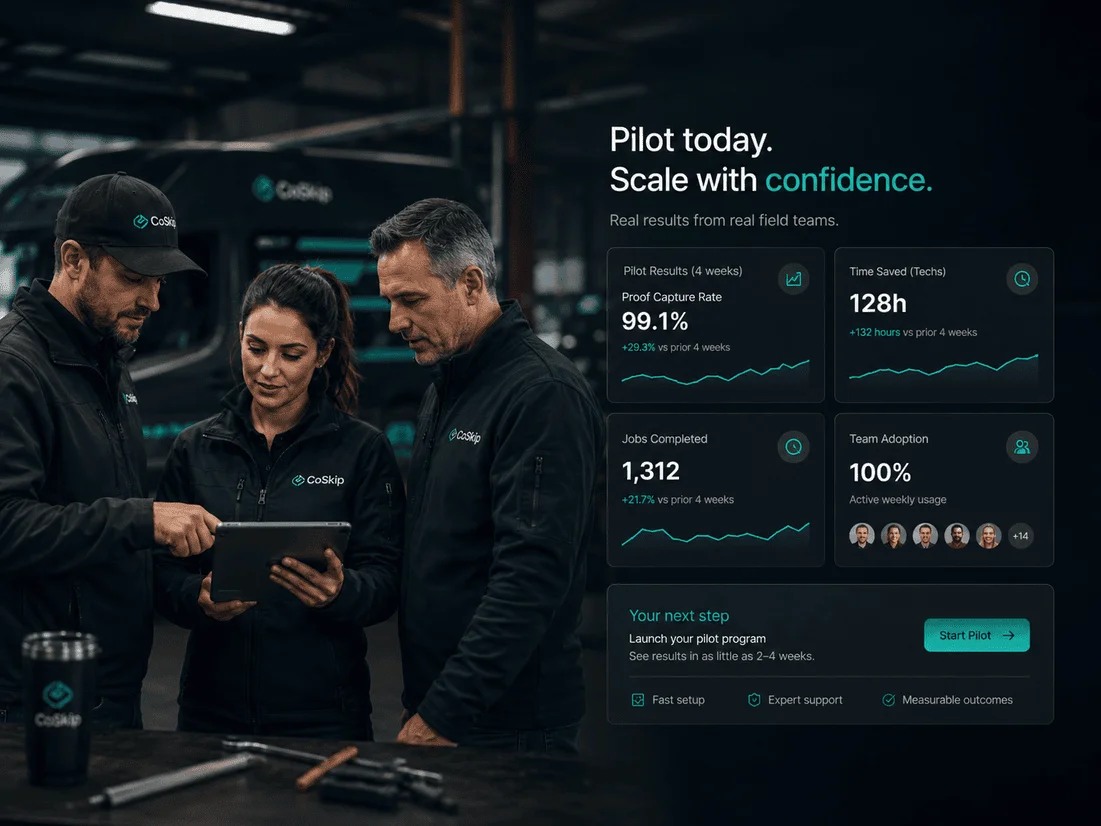
CoSkip pilot workflow preview showing one workflow moving from setup to field test and review.
02

Proof-of-work packet

Photos, notes, timestamps, signoff, and exports.

03

Field test plan

Focused rollout with field leads and feedback loops.

04

Pilot results review

Technician adoption, guidance quality, closeout completeness, and friction signals.

05

Scale recommendation

Expand, refine, integrate, or pause with clarity.

Workflow scoping session

We identify one high-friction field workflow and define what success should look like.

Guided workflow prototype

CoSkip turns your procedure into voice-friendly guidance, visual context prompts, proof requirements, and exception paths.

Proof-of-work packet

Photos, timestamps, notes, signoff, and verified steps are organized into a close-out record.

Field test plan

A small group of technicians or field leads tests the workflow in realistic conditions.

Pilot results review

We review what changed across technician adoption, escalation frequency, information search time, closeout completeness, exceptions, and workflow friction.

Scale recommendation

You receive a recommendation for whether to expand, refine, integrate, or pause.

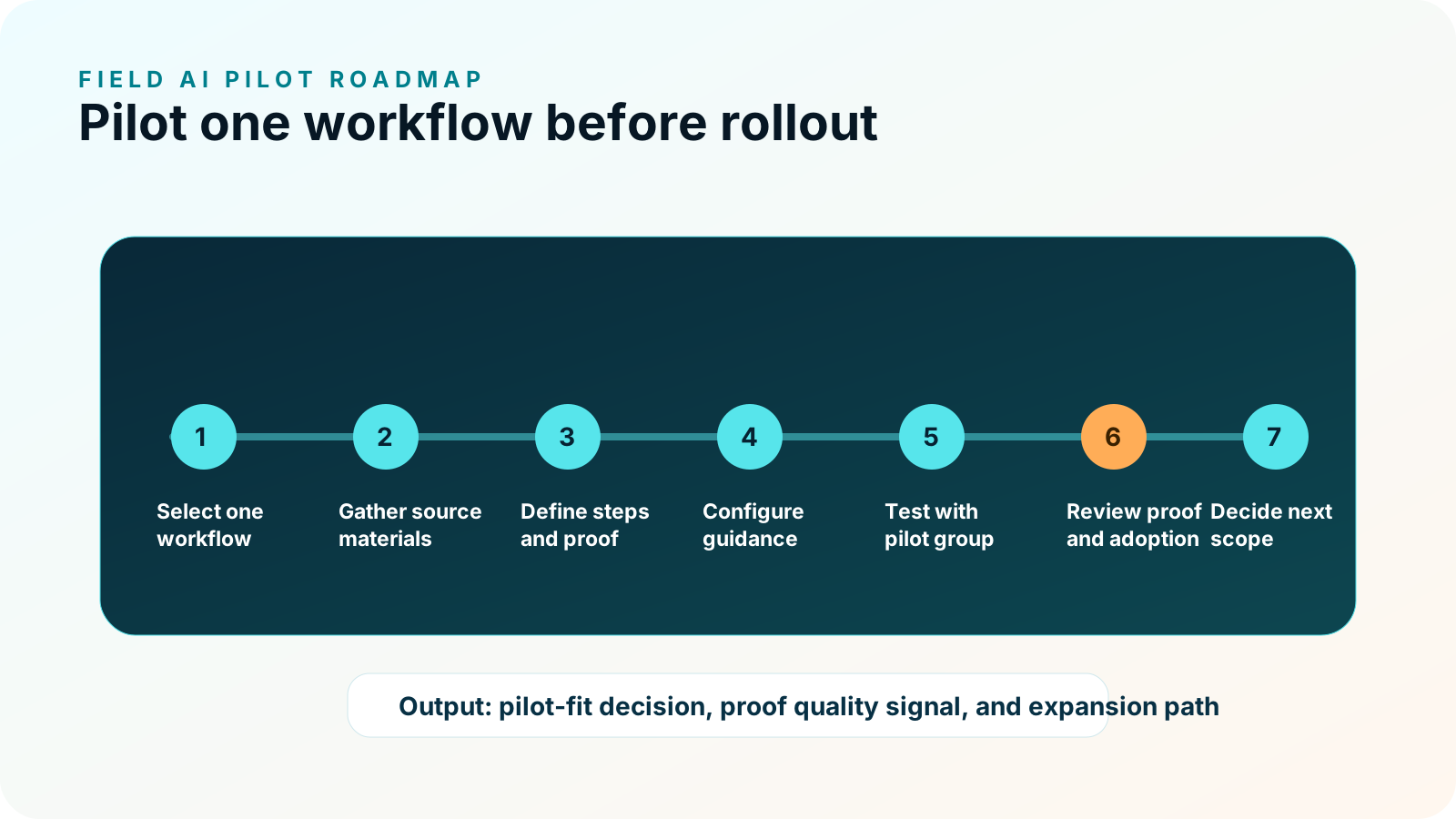
Field AI pilot roadmap diagram showing workflow scoping, proof map, guided prototype, field test, results review, and scale decision.
Field AI pilot roadmap: scope one workflow, define the guidance path, configure trusted knowledge, test with field leads, review results, and decide whether to scale. Check readiness →
Pilot inputs

What CoSkip needs from pilot partners

These inputs keep the pilot focused on a real workflow instead of becoming an open-ended implementation.

Check if you are ready
01

One target workflow

HVAC PM close-out, facilities inspection, warranty repair, safety inspection, commissioning checklist, or similar.

02

3-5 sample procedures

SOPs, checklists, manuals, photos, troubleshooting notes, expert instructions, or close-out forms.

03

One pilot owner

An operations leader, service manager, or field leader who can keep the pilot moving.

04

1-2 field leads

Technicians, supervisors, or team leads who can test and provide practical feedback.

05

Baseline metric

Current close-out time, callback rate, proof completeness, inspection consistency, or rework rate.

06

System and security context

CMMS/FSM, SSO/MDM needs, data retention expectations, device environment, and review path.

Pilot planning guides

Prepare the workflow, the technicians, and the guidance path.

Use these guides before the pilot kickoff to keep scope tight, source materials ready, and technician adoption practical.

Field technician guidance for repeatable workflows

A strong pilot starts with one workflow where technician guidance, proof capture, exceptions, and review needs are clear.

Read the guidance article →

How to pilot field service AI on one workflow

Define one workflow, guidance sources, pilot users, reviewers, systems, and success metrics.

Read the pilot guide →

What field teams should prepare before an AI pilot

Gather SOPs, sample jobs, source materials, field leads, security needs, and closeout paths.

Read the readiness guide →

Technician adoption checklist for field service AI

Plan technician trust, voice usability, visual context, supervisor review, and feedback loops.

Read the adoption checklist →
6-10 week path

A focused pilot path, not an endless implementation

The goal is to test one real workflow quickly, learn from the field, and decide whether to expand.

Pilot roadmap

One workflow, four focused phases

The roadmap keeps the pilot practical: scope, configure, field test, and review before any broader rollout.

  1. 01
    Scope workflow

    Pick the workflow and success metric.

  2. 02
    Configure guidance

    Turn procedures into voice and visual field guidance.

  3. 03
    Field test

    Validate with field leads in real conditions.

  4. 04
    Review results

    Assess adoption, escalations, closeout, and next steps.

3-5 procedures1 pilot owner1-2 field leadsMeasurable outcome
The pilot roadmap keeps scope tight: one workflow, a few procedures, field leads, and one measurable outcome.
Week 0-1

Scope and success criteria

  • Select workflow
  • Confirm team
  • Gather procedures
  • Define success metrics
Pilot brief and workflow map
Week 2-3

Procedure-to-guidance setup

  • Turn procedures into voice and visual guidance
  • Define source materials
  • Add exception paths
  • Review devices and security
Configured pilot workflow
Week 4-6

Field test and feedback

  • Test with field leads
  • Refine unclear guidance
  • Validate closeout quality
  • Capture technician feedback
Field-tested guidance workflow
Week 7-10

Rollout, measurement, and next-step plan

  • Expand to pilot group
  • Measure success criteria
  • Identify integration needs
  • Decide expand, refine, or pause
Pilot results and scale recommendation
Example workflows

Start with one workflow that is painful, repeatable, and measurable

Utilities, industrial, facilities, and regulated operations

Safety or compliance inspection

Pain: Audit gaps, incomplete steps, inconsistent evidence.

Safety confirmationsTimestampsException photosInspection summary
Check readiness →
Measured pilot

What we measure during the pilot

A good pilot is not just a demo. It should produce measurable evidence about whether voice and visual guidance improves how technicians get work done.

Adopt

Technician adoption

Whether technicians use the guidance and find it practical during real work.

Search

Information search time

Time spent looking for manuals, SOPs, notes, or senior-tech support.

Escalate

Escalation frequency

How often technicians need follow-up support for repeatable questions.

Closeout

Closeout completeness

Whether notes, evidence, exceptions, and signoff are easier to review.

Review

Manager review time

Whether cleaner closeout reduces chasing, clarification, and manual review time.

Scale

Pilot scalability

Whether the workflow should expand, be refined, integrated, or paused.

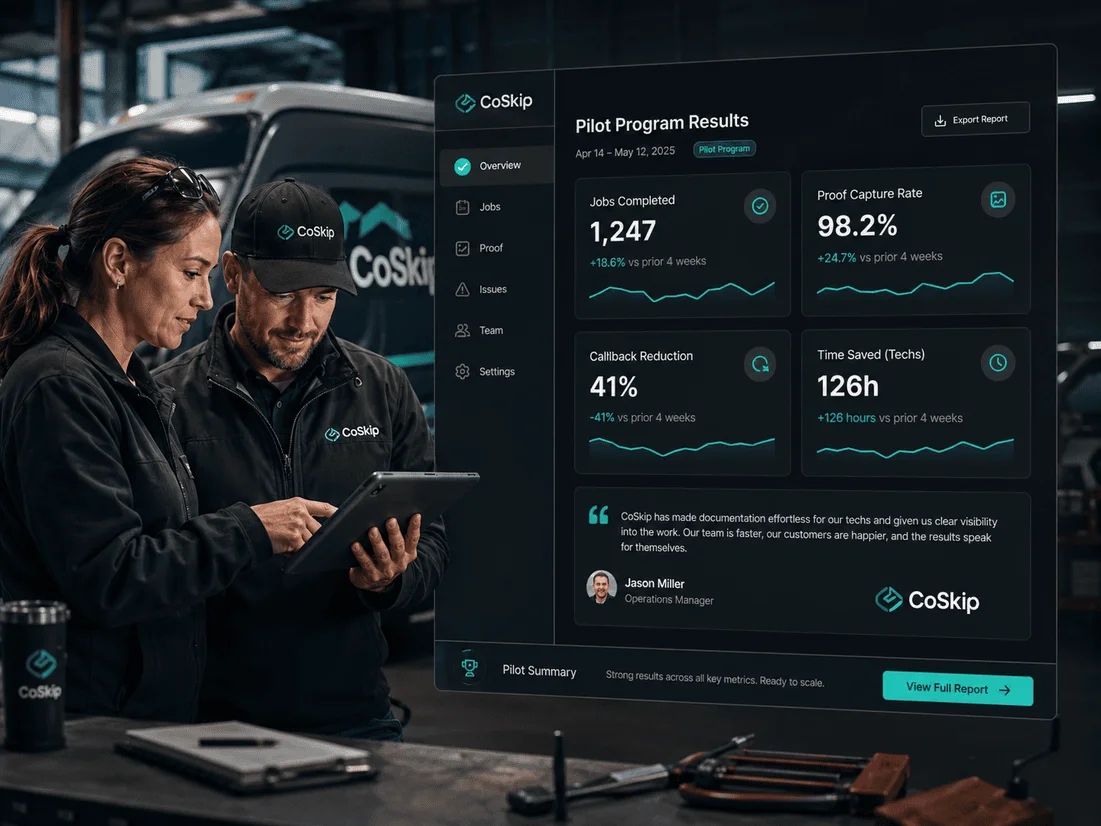
CoSkip pilot review visual showing workflow fit, proof completion, field feedback, and next-step readiness.

Pilot metrics are directional and depend on workflow, adoption, devices, connectivity, procedure quality, and pilot scope.

Field conditions

Built for real field conditions and enterprise review paths

Devices and field environment

We confirm phones/tablets, connectivity, noise, PPE, gloves, offline needs, and field conditions before testing.

iOS / AndroidHands-free useOffline-aware planningField constraints

Security and data expectations

Pilot scoping includes SSO/SAML, MDM, retention, access control, audit logs, and data-review requirements where relevant.

SSO / SAMLMDM-readyZero-retention optionRBAC / audit logs

Systems and integrations

A pilot can start with manual export, structured reports, API/webhook planning, or system-of-record integration depending on scope.

ServiceTitanUpKeepFiixSAP PMNetSuiteAPI / webhooks
Systems path

Manual review first, integration when scoped

A pilot can prove the workflow before committing to API, webhook, or system-of-record implementation work.

  1. Field workflow

    Technicians test one guided process.

  2. Proof packet

    Evidence is organized for review.

  3. Review / export

    Operators validate the output first.

  4. API / webhook

    Technical scope follows the pilot.

  5. System record

    Route data where it belongs.

Scoped systems FSMCMMSEAMGISWork orders
Integration planning can stay scoped during the pilot: manual review and export first, then API, webhook, or system-of-record paths where they make sense.
Apply

Apply for the AI Guidance Pilot

Tell us about your field team, workflow, and guidance goals. We'll use this to determine fit and recommend the best starting point.

Workflow fit review Readiness recommendation Pilot scoping next step

What happens after you apply?

  • We review your workflow fit.
  • We confirm pilot readiness.
  • We identify the best starting workflow.
  • We recommend next steps.
1 workflow6-10 weeksMeasurable outcomes

Not ready to apply yet?

Use the readiness score or ROI Calculator to prepare your pilot business case.

Check readiness Calculate ROI
Contact
Company and team
Pilot workflow
Goals
Security / IT
After the pilot

What happens after the pilot?

A good pilot should create clarity. The goal is not to force a rollout; it is to prove whether CoSkip can create measurable value on real work.

Expand

If the workflow performs well, expand to more teams, regions, or related workflows.

Refine

If results are promising but adoption or procedures need work, refine the workflow and test again.

Pause

If the workflow is not a good fit, capture what was learned and identify a better starting point.

FAQ

AI Guidance Pilot questions

Do we need to be fully ready before applying?

No. You should have a likely workflow and a willingness to gather sample procedures, but the Field AI Readiness Score can help identify gaps before pilot scoping.

How many technicians should participate?

A focused pilot can start with a small group of field leads or technicians. The strongest fit is usually one team with enough recurring work to measure outcomes.

Can technicians ask CoSkip questions by voice?

Yes. The pilot can evaluate voice-first technician questions, step guidance, and source-grounded support where the workflow and source materials are ready.

What kinds of source materials can CoSkip use?

SOPs, checklists, manuals, troubleshooting notes, job notes, expert instructions, inspection forms, and close-out templates can all help define the guidance path.

Do we need an integration before the pilot?

Not always. A pilot can start with scoped source materials, guided workflows, exports, or manual review while integration requirements are clarified.

What security requirements can be considered?

Pilot scoping can include SSO/SAML, MDM, access control, retention, audit logs, data review, and security review paths where relevant.

What if our workflow is not HVAC?

CoSkip is designed for repeatable field workflows across service, facilities, maintenance, warranty, compliance, and inspection-heavy operations.

What does success look like?

Success depends on the workflow, but common signals include technician adoption, reduced information search time, fewer escalations, clearer closeout, faster manager review, and better first-time-fix indicators.

Can we see the product before applying?

Yes. Watch the AI Guidance Demo and review the AI Technician Assistant page to understand the experience before applying.

Ready when you are

Ready to pilot AI guidance on one workflow?

Apply for the AI Guidance Pilot or use the readiness and ROI tools to prepare one practical workflow for field testing.

One workflowVoice + visual guidanceScale recommendation

Apply to Become a Pilot Partner

Tell us a bit about your team. We'll follow up with next steps.

Join the Waitlist

Get launch updates and early access invites.