Check field AI readiness across workflow clarity, source materials, proof requirements, devices, reviewers, security, and pilot metrics before scoping one AI-guided workflow.
Identify your best first pilot workflow
Find gaps before field rollout
Get a score across workflow, proof, device, security, and pilot readiness
Recommended first stepStart with one repeatable workflow and gather 3-5 sample procedures.
Path
Readiness
ROI
Demo
Pilot
What this checks
The assessment focuses on operational readiness: repeatable field work, usable procedures, devices, proof requirements, integrations, security, and pilot ownership.
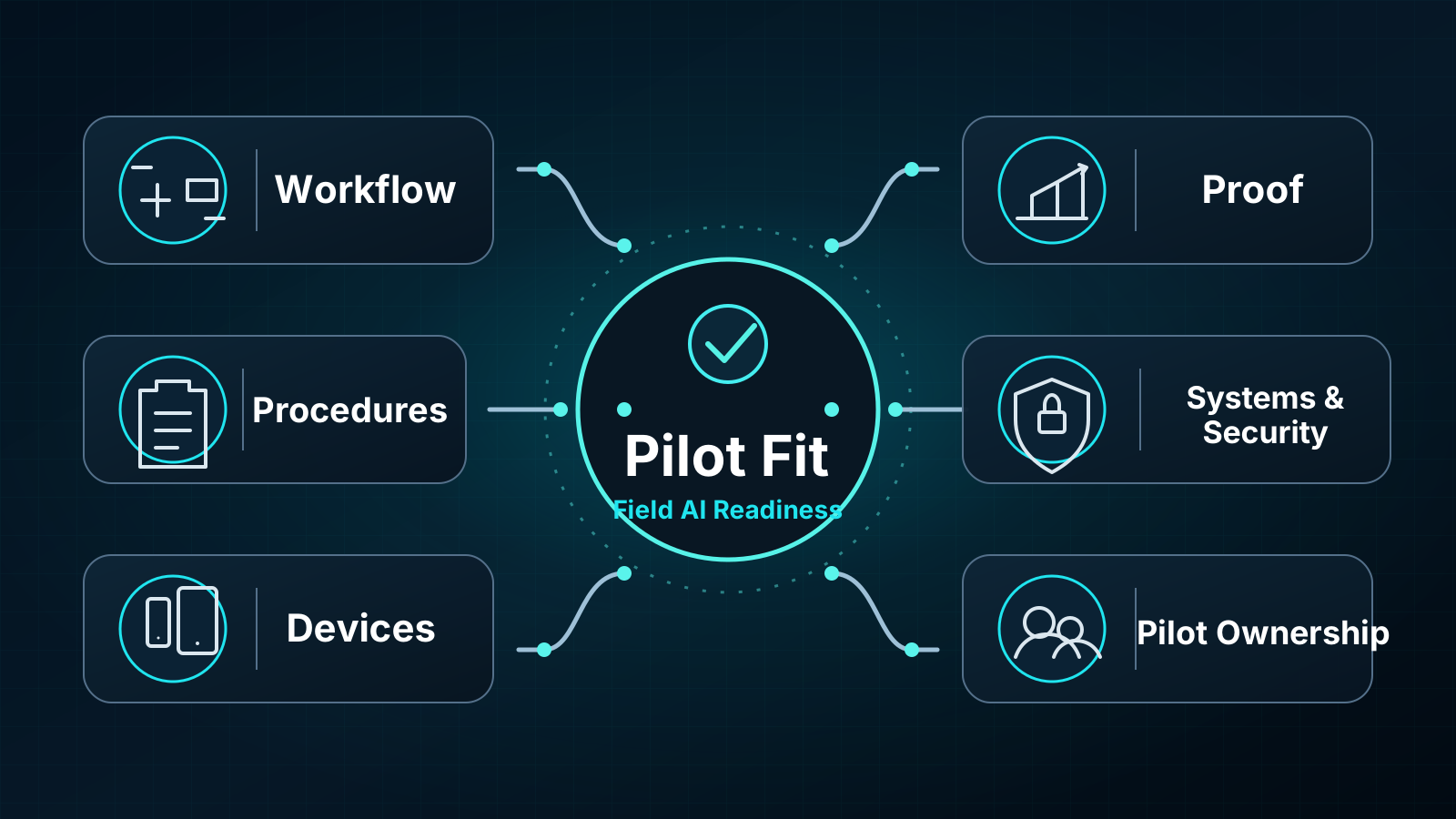
Diagnostic frameworkVoice-to-proof pilot readiness
Workflow, procedures, field environment, proof, systems, and ownership all need to line up for a useful pilot.
Workflow fit
Repeatable field work with measurable pilot impact.
Procedure readiness
SOPs, checklists, photos, manuals, or expert notes.
Device readiness
Devices, connectivity, noise, PPE, and jobsite conditions.
Proof need
Photos, timestamps, signoff, warranty, customer, and audit records.
Security path
CMMS/FSM, APIs, SSO/SAML, MDM, retention, and review paths.
Pilot clarity
Operations owner, field leads, baseline metrics, and success criteria.
Readiness map
Six categories for pilot fit
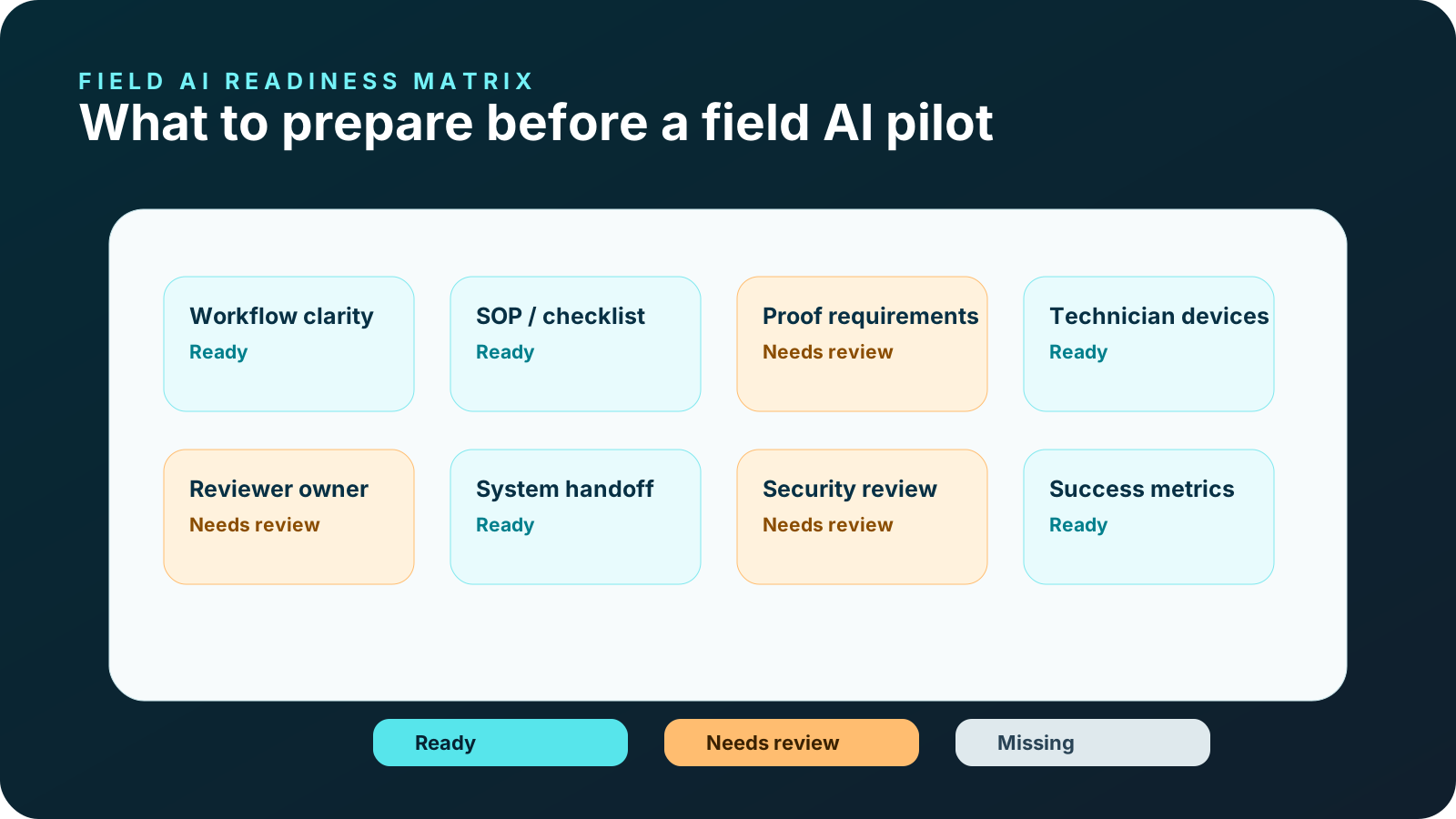
This is a category map, not a fake score result. The quiz checks whether the foundation is clear enough to scope one pilot.
The assessment checks whether your first CoSkip pilot has the workflow, procedure, proof, device, security, and ownership foundation it needs.
Field AI readiness matrix: one pilot is easier to scope when workflow fit, procedure readiness, proof need, field environment, systems, security, and ownership are visible together. Start the readiness score →
Workflow fit
Checks whether you have a repeatable, high-friction field workflow that can produce measurable pilot impact.
Procedure readiness
Checks whether SOPs, checklists, manuals, photos, or expert notes are available for AI-guided workflows.
Device and connectivity readiness
Checks whether technicians have usable devices and whether field conditions are understood.
Proof-of-work and compliance need
Checks whether photos, timestamps, signatures, measurements, warranty evidence, or audit records matter.
Integration and security readiness
Checks whether your CMMS, FSM, ticketing, data, and security requirements are clear enough for pilot scoping.
Pilot ownership and ROI clarity
Checks whether the right operators, field leads, sponsors, and success metrics are in place.
From readiness to workflow visibility
See what readiness looks like in a field workflow.
If your workflow has unclear handoffs, missing proof, or exception notes that are hard to review, see how an AI-assisted field workflow can make the process visible before a sales conversation.
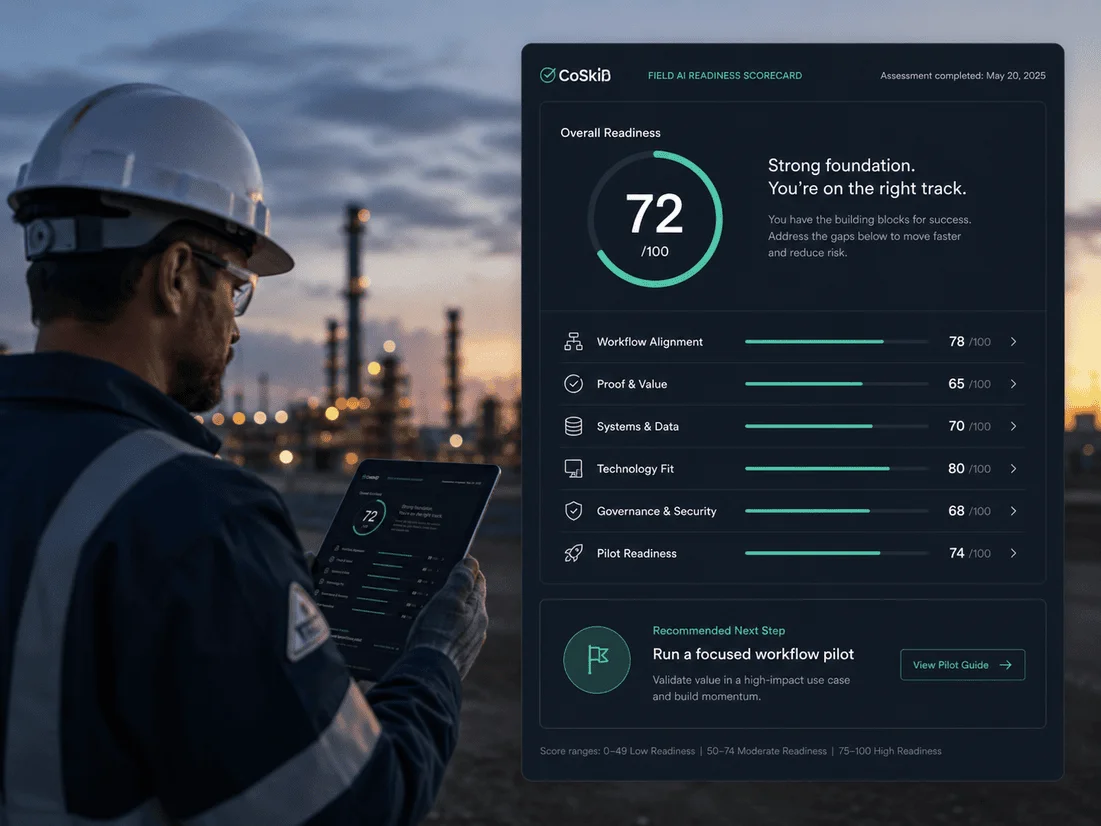
This sample shows the kind of score, category signals, strengths, watch areas, and next-step guidance you will see immediately after the quiz. No email is required to view your result.
Answer 12 operational questions. Your score appears immediately; email is only needed if you want CoSkip to follow up with a detailed report.
Your scorePilot-Ready
0out of 48
Field AI Readiness Score
Category breakdown
Top strengths
Readiness gaps
Recommended next step
Dynamic recommendations
Get your detailed readiness report
Share your score with CoSkip and get a pilot-readiness follow-up tailored to your workflow, proof-of-work needs, and systems.
30 operational checks
Field AI Readiness Checklist
30 checks before launching voice-guided workflows, AR assistance, and automated proof-of-work.
Workflow fit
We have selected one high-friction workflow.
The workflow happens often enough to measure impact.
The workflow has repeatable steps.
We know where technicians lose time today.
We know which sites, crews, or regions should be in pilot scope.
Procedure readiness
We have SOPs, manuals, checklists, or expert notes.
We can provide 3-5 sample procedures.
We can identify edge cases and exceptions.
We have photos, diagrams, or reference media where useful.
A field expert can review pilot workflow content.
Proof-of-work
We know what proof must be captured.
Required photos, measurements, timestamps, or signoffs are defined.
Customer, warranty, audit, or compliance needs are clear.
We know what currently causes rework, disputes, or rejected claims.
Supervisors know how proof will be reviewed.
Device and field environment
Technicians have reliable phones or tablets.
Device management or access requirements are understood.
Connectivity constraints are known.
PPE, gloves, noise, ladders, or hands-free needs are understood.
The pilot environment can support safe field use.
Integration and security
The system of record is identified.
A system owner is identified.
API, webhook, export, or manual pilot path is understood.
SSO, MDM, DPA, retention, and audit requirements are known.
Security review owner and timing are clear.
Pilot execution
An executive sponsor or senior operations owner is identified.
One pilot owner is accountable.
1-2 field leads can support rollout.
Success metrics and baselines are defined.
A training and feedback plan exists.
Readiness guides
Go deeper on pilot prep and technician adoption
Use these guides after the readiness score to turn the result into one practical workflow review. Teams ready to define the evidence layer can evaluate field service proof-of-work software.
Checklist
Field service AI readiness checklist
Use the five-gate framework to check one workflow's procedure, proof rules, exceptions, ownership, and pilot scope.
Readiness is the diagnostic. ROI, demo, proof packet, and pilot scoping help turn the result into an action plan. Get the Field AI Pilot Kit to bring your readiness signal into a practical pilot plan.
Worksheet
Field AI Pilot Readiness Worksheet
Score one workflow across repeatability, source materials, proof, devices, reviewers, systems, and metrics.
CoSkip uses essential cookies to make our site work and optional analytics to understand usage.
You can manage preferences below or at any time. We also honor the
Global Privacy Control (GPC) signal.